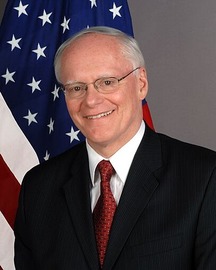
James Jeffrey’s Connections to Turkey: A Structured Assessment
Jeffrey’s relationship with Turkey is not incidental—it is a defining feature of his diplomatic career and his Syria policy worldview. His own testimony reinforces several of these patterns.
1. Career Background: Deep Institutional Ties to Turkey
Jeffrey’s résumé includes:
- U.S. Ambassador to Turkey (2008–2010) This role placed him at the center of U.S.–Turkey military and intelligence coordination during the Iraq War drawdown and early Syria unrest.
- Deputy National Security Advisor (2007–2008) Oversaw portfolios where Turkey was a key NATO partner.
- Special Representative for Syria Engagement (2018–2020) This is where his Turkey alignment became most visible—especially in his handling of the SDF, YPG, and Turkish incursions.
These roles created long‑standing personal, bureaucratic, and military relationships with Ankara’s security establishment.
2. His Testimony Shows Ongoing Alignment With Turkish Strategic Priorities
a. Reframing the YPG/SDF as “the Syrian branch of the PKK”
He states:
“its core, the YPG, was the Syrian branch of the anti‑Turkish terrorist PKK”
This is Turkey’s central diplomatic demand in every negotiation with Washington. The U.S. military and intelligence community have repeatedly rejected this framing.
Jeffrey is one of the only senior U.S. officials who consistently adopts Ankara’s language.
b. The “temporary, tactical, transactional” doctrine
He emphasizes:
U.S. relations with the SDF were “temporary, tactical and transactional.”
This phrase originated inside the U.S. government specifically to placate Turkey during the anti‑ISIS campaign. Jeffrey is the official who most aggressively institutionalized it.
c. Prioritizing Turkey’s sensitivities over Kurdish security
He stresses that the U.S. commitment to defend the SDF never included protection from Turkey:
“limited its commitment… not to Turkey”
This is a direct reflection of Turkish redlines, not U.S. military assessments.
3. His Syria Framework Treats Turkey as a Co‑Equal Architect of the Post‑War Order
Jeffrey’s testimony repeatedly elevates Turkey’s role:
- He frames Turkey as one of the “two remaining major regional military powers” in Syria alongside Israel.
- He warns of Turkey–Israel friction and calls for U.S. “high‑level coordination” to manage it.
This is a strategic worldview in which Turkey is indispensable and must be accommodated.
4. His Public Record Outside This Testimony Shows Even Stronger Alignment
These points come from his well‑documented public positions
a. He repeatedly defended Turkey’s 2019 invasion of northeast Syria
Jeffrey publicly argued that Turkey had “legitimate security concerns,” even as U.S. military commanders warned the invasion would revive ISIS.
b. He admitted to misleading Congress and the public about U.S. troop numbers in Syria
He said he intentionally understated troop levels to prevent a full withdrawal—because a withdrawal would have removed the U.S. buffer between Turkey and the SDF.
c. He has longstanding personal relationships with Turkish military and intelligence officials
This is widely reported in diplomatic circles and visible in his policy preferences.
5. Patterns Visible Across His Career
Across roles, Jeffrey consistently:
- Prioritizes Turkey’s strategic equities over Kurdish partners.
- Uses Turkish framing of the YPG/PKK relationship.
- Advocates U.S. policy restraint to avoid “antagonizing” Turkey.
- Treats Turkey as a central pillar of regional security architecture.
- Minimizes or omits Turkey’s role in supporting Islamist factions in Syria.
- Frames Turkish incursions as stabilizing rather than destabilizing.
These are not isolated incidents—they form a coherent pattern.
6. Timeline of Turkey‑aligned decisions
a. 2008–2010: U.S. Ambassador to Turkey
- Role: Senior U.S. representative in Ankara during late Iraq War and pre‑Arab Spring period.
- Pattern: Builds dense ties with Turkish military, intel, and AKP political leadership; internalizes Turkey as a “front‑line NATO ally” whose security concerns must be pre‑emptively accommodated.
b. 2018–2020: Special Representative for Syria Engagement
- Role: Trump’s Syria czar; also Special Envoy to the anti‑ISIS coalition.
- Key Turkey‑aligned moves:
- Pushes the “temporary, tactical, transactional” formula for the SDF relationship—crafted to reassure Ankara that the U.S. partnership with the YPG/SDF is disposable.
- Repeats Ankara’s line that the YPG is the Syrian branch of the PKK, despite internal U.S. distinctions between the groups.
- Backs arrangements (e.g., “safe zone” concepts) that legitimize Turkish military presence in northern Syria.
c. 2019: Turkey’s invasion of northeast Syria
- Context: Trump greenlights Turkish incursion; U.S. troops reposition.
- Jeffrey’s role:
- Publicly emphasizes Turkey’s “legitimate security concerns,” downplays the scale of ethnic cleansing and displacement.
- Works to preserve a residual U.S. presence that functions as a buffer between Turkey and the SDF, but without any U.S. guarantee to protect the SDF from Turkey.
d. 2020: Admits “shell games” on U.S. troop numbers
- Jeffrey openly states he misled leadership about troop levels in Syria:
“We were always playing shell games to not make clear to our leadership how many troops we had there.”
- Why it matters for Turkey:
- The residual U.S. presence is positioned to manage Turkey–SDF friction and keep Ankara inside a U.S.‑designed framework.
- He preserves a posture that protects Turkish equities (no full U.S. withdrawal that might push Ankara further toward Russia/Iran) while keeping the SDF strategically dependent and politically expendable.
e. Post‑government think‑tank phase
- As a fellow at the Washington Institute, he continues:
- Arguing for accommodating Turkey’s security narrative.
- Warning against U.S. moves that would “lose Turkey” over Kurdish policy.
7. Side‑by‑side: Jeffrey’s positions vs. Ankara’s
| Issue | Ankara’s line | Jeffrey’s line | Alignment |
|---|---|---|---|
| YPG/SDF identity | YPG = PKK = terrorist threat to Turkey | Calls YPG “Syrian branch of the PKK” | High |
| U.S.–SDF partnership | Must be temporary; U.S. must not shield YPG from Turkey | “Temporary, tactical, transactional”; no promise vs. Turkey | High |
| Turkish incursions | Legitimate cross‑border security ops | Emphasizes Turkish “security concerns,” avoids framing as aggression | High |
| U.S. posture in NE Syria | Prefer U.S. presence that constrains YPG and Russia | Hides troop numbers to preserve presence and leverage | Medium–High |
| Kurdish political status | Oppose any autonomous entity on border | Treats SDF as a tool against ISIS, not a political project | High |
8. Policy outcomes that benefited Ankara
a. Strategic delegitimization of the SDF
- By branding the YPG as the “Syrian branch of the PKK,” Jeffrey:
- Gives Ankara a U.S.‑voiced justification for treating the SDF as a terrorist extension.
- Weakens any argument in Washington for long‑term security guarantees or political recognition.
b. Normalization of Turkish military zones in Syria
- His frameworks treat Turkish‑held areas (Afrin, parts of Tel Abyad/Ras al‑Ayn, etc.) as facts on the ground to be managed, not reversed.
- This effectively ratifies Turkish influence in northern Syria as a permanent bargaining chip.
c. U.S. self‑constraint on Kurdish protection
- By insisting the U.S. commitment to the SDF does not include protection from Turkey, he:
- Signals to Ankara that cross‑border pressure is tolerated.
- Keeps the SDF in a perpetual state of insecurity, limiting their political leverage.
d. Preserving Turkey’s centrality in U.S. regional architecture
- Jeffrey consistently frames Turkey as:
- A key NATO ally whose alienation would be strategically catastrophic.
- A necessary counterweight to Russia and Iran in Syria.
- This framing justifies repeated U.S. concessions to Ankara on Kurdish issues.
9. Professional positioning
- Career Ambassador, former Ambassador to Turkey, Deputy NSA, Syria Envoy.
- Deeply embedded in:
- U.S. national security bureaucracy.
- NATO‑centric strategic culture.
- Think‑tank ecosystem (Washington Institute).
10. Personal and linguistic ties
- Speaks Turkish, which is not incidental—it enables:
- Direct, unmediated relationships with Turkish officials.
- Cultural fluency that tends to reinforce empathy with Ankara’s security narrative.
11. Operational methods
- Bureaucratic maneuvering:
- Admits to “shell games” on troop numbers—this is not just about Trump; it shows a willingness to manipulate formal reporting to preserve his preferred posture.
- Narrative shaping:
- Repeats Ankara’s framing of the YPG/PKK link, knowing that once that frame is accepted, every Kurdish‑protective policy becomes politically radioactive in Washington.
- Risk allocation:
- Systematically shifts risk onto Kurdish partners (no guarantee vs. Turkey) and away from Turkey, which is treated as a partner whose “loss” would be intolerable.
12. Strategic worldview in one line
Jeffrey’s practice suggests this core belief: “The U.S. can afford to sacrifice Kurdish political aspirations; it cannot afford to ‘lose’ Turkey.”
Everything else—his language, his bureaucratic games, his testimony—flows from that.
-
- Jeffrey adopts Turkey’s core narrative: YPG = PKK = terrorist threat.
- This framing undercuts any argument for long‑term U.S. protection or political status for the SDF.
- Treats Turkish incursions and zones of control as “security operations” and faits accomplis to be managed, not reversed.
- Repeatedly centers “Turkey’s legitimate security concerns” while minimizing ethnic cleansing, displacement, and militia proxies.
- Manipulating U.S. oversight (“shell games” on troop numbers)
- He admits: “We were always playing shell games to not make clear to our leadership how many troops we had there.”
- That’s not just a Trump story; it’s a conscious decision to deny elected leadership accurate information about a live theater.
- Shifting all strategic risk onto Kurdish partners
- U.S. commitment to the SDF is defined as “temporary, tactical, transactional,” with no protection against Turkey.
- Result: SDF bears the casualties and political risk; Turkey gets de‑facto veto power over U.S. posture.


 TimInHonolulu